Lost and found

18 Sep
(Following the assassination of Charlie Kirk, New York City’s Young Republican Club organized and gathered in Madison Square Park in Manhattan for a vigil in support of the conservative activist. Andrea Renault/STAR MAX/IPx/AP Images)

This post is a homily I delivered to the parish I currently serve as “Deacon Vicar,” St. Andrew’s Episcopal Church, Somerset Parish, Princess Anne, Maryland on Sunday, September 14 which was the Fourteenth Sunday after Pentecost, Proper 19.

The Collect of the Day: O God, because without you we are not able to please you, mercifully grant that your Holy Spirit may in all things direct and rule our hearts; through Jesus Christ our Lord, who lives and reigns with you and the Holy Spirit, one God, now and for ever. Amen.

The Lectionary readings: Jeremiah 4:11-12, 22-28, Psalm 14, 1 Timothy 1:12-17 and Luke 15:1-10.


I had a distant uncle (very distant!) whom I met once when I was a teenager.  That was on a trip of a lifetime, which I had zero appreciation for in the moment.  It’s one of those experiences that cannot be replicated.  During the summer in between my sophomore and junior years of high school, my mother, partner and I took a month-long train trip out west.  I know Amtrak has a horrible reputation (a lot of which is ‘deserved’) but if you ever have the opportunity to take a long train ride within the United States, I highly recommend it.   It’s a great way to see our country!

At the time, I was missing my friends, worrying I was going to miss out on something (that was the kind of teenager I was).  My mother and I have recently been ‘revisiting’ that trip, because she routinely goes through our photo albums and brings out photos to show me and guests who happen to be visiting (like what happened at the recent healing service, with that baby picture appearing in a recent Andrewgram).  The pictures of course cannot capture the magnificent, majestic landscapes we are blessed to have.  We visited the Grand Canyon, Yellowstone National Park, the Grand Tetons National Park, among other sites, as well as Salt Lake City, Utah.

That’s where my uncle (Uncle Stew) lived.  And he was a Mormon. He was a pleasant enough fellow.  I do not remember too much about him.  Unfortunately, most of what I remember is how he tried to convert all of us to the Mormon church!  He had us watch countless videos, took us to see some of the Mormon sites (we were not allowed into others because of not belonging to the church, or, at least that’s what he told us). 

(The Salt Lake Temple)

In light of Charlie Kirk’s assassination on Wednesday afternoon, and learning that the assailant, Tyler Robinson, is supposedly a Mormon, I thought of Uncle Stew.  There’s much about the Mormon church that remains a mystery to me.  At its core, however, is the Bible and profession of Christ as God’s Son, “who serves as the Savior.”  And so, I can only imagine the amount of “soul searching” that is currently happening, within Tyler’s family (also purportedly Mormon) and their faith community at large, regarding how Tyler became a lost sheep, who strayed from the commands of Christ, specifically, in this instance, the command to love his neighbor and not to kill or take another life. 

Unfortunately, however, there’s quite a bit of ‘clucking’ happening with respect to his family ‘needing to have done more,’ and the clucking is particularly focused on their failure to keep Tyler from straying and becoming a lost sheep.  But there’s also clucking directed at Charlie Kirk, for either opinions expressed, or regarding the ‘type of faith’ he led and professed.  The crux of all this clucking wants us to acknowledge how much both – Charlie and Tyler – need/needed to repent, and to be counted again amongst the righteous, as both were….. lost sheep.

Before Kirk was killed, I was reminded of the thief on the cross, who hung next to Jesus at the crucifixion, by way of one of my daily devotional books.  As I have watched the horrible social media comments pile here, there and everywhere, I frequently re-read the quote since Kirk’s assassination.  It comes from Makarios the Great, a monk in Egypt, who lived in the fourth century. Because today in the Roman Catholic Church is the Feast of the Exultation of the Holy Cross, known as Holy Cross Day in the Episcopal Church (which is transferred to tomorrow since today is Sunday, which takes precedence in our tradition) I want to share it.  Here’s what St. Makarios wrote:

All things are possible for God.

Such was the case of the thief [on the cross].

In one moment he was converted through his faith

and was restored to paradise.

It was for this that the Lord came,

so that he might change our souls, re-create them,

and as scripture says,

“make us sharers in the divine nature.”

He will give to our soul a heavenly soul,

which is the Holy Spirit,

who will lead us into the fullness of virtue,

so that we will even start to live the eternal life,

as far as this is now possible.Makarios the Great     

Technically, the thief was a not a lost sheep because prior to that moment he had not professed faith in Christ and it’s a conversion story.  But he and those who are lost sheep have one important, very important act to do, before coming or coming back into the fold: profess the Holy Name of Jesus and/or repent, Confess.  But each time we confess, for me, we truly do profess the Holy Name of Jesus.  We’ll shortly pray our Confession with a profession: for the sake of your Son, Jesus Christ, have mercy on us and forgive us….

Clearly, Tyler needs to do some hard, hard work.  I do pray some sort of prison ministry awaits him and that his heart will unharden.  I know it’s hard, but Tyler needs our prayers.  Even if the shooter ended up being a different race or was indeed part of the transgender community, our prayers are still required.  We are to pray, unceasingly, even when and especially when hearts remain hardened.  It’s quite possible Tyler and even Dylan Roof (the Charleston, Mother Emmanuel shooter) will eventually be part of the fold. Think about that(!).  If (…big if…) Dylan Roof truly does the hard, needed work, Professes and Repents/ Confesses, even after methodically killing 9 unarmed African American Bible study attendees, he would be our brother in Christ.  That’s an uncomforting, unsettling thought.  But to authentically proclaim, may have us be unsettled, uncomfortable, out of our comfort zones (think back to my recent homily about Jesus coming to ‘cause division’).     

And Charlie Kirk?  Well…not doubt it’s going to depend on your perspective and how you perceived him.  Remember this: he professed Jesus and yet, like us, all of us, was a sinner.  The church is comprised of sinners, weekly we confess our sins, because as we prayed in this morning’s Collect, without God, we are unable to please him without the grace of the Holy Spirit.  Because we too can get lost.  You may want to check your bearings; Jesus may indeed be out looking for you right now.  Ask: am I the lost sheep?  We cannot pretend to know what was further required of Charlie Kirk when called to account at the last Great Day, which, unfortunately, for him the last day was this past Wednesday afternoon at around 2:20 p.m. EST.  

I’m a member of the LGBTQ+ community.  I admittedly did not pay too close attention to Charlie Kirk because he and I had differing takes with respect to “the gay issue.”  Even with that, I do feel confident he would have sat down with me to have a conversation in the same way Pastor Timothy Keller would have (I spoke about that in a homily that focused on Timothy Keller when he died).  While I do take issue with “love the sinner, hate the sin” ‘approach’ with respect to ‘the gay issue[1],’ I want to highlight two areas of misconceptions that I stumbled across since Kirk died because I’m frankly beyond sick and tired of watching on my phone or laptop someone getting shot and then dying, with having to then watch a wave of celebration erupt after the person dies.

Too many in the ‘celebratory camp’ shared a portion of a quote from Kirk and it was not flattering.  As is usually the case, the entire quote was not shared but clipped.  The quote: 

[clipped quote “I can’t STAND the word empathy, actually. I think empathy is a made-up, new-age term, and it does a lot of damage.”] But the full quote continues “I much prefer the word compassion, and I much prefer the word sympathy. Empathy is where you try to feel someone’s pain and sorrows as if they’re your own. compassion allows for understanding.”  Our Christian canon (NT) was written in Greek; there is an underlining Greek word for empathy, but it’s fairly modern, coming I believe from the field of psychology.  So, I would not necessarily frame empathy as ‘new-age’ but yes, many Bible translations have Jesus being moved with pity… or compassion.

As for ‘the gay issue’: just after Kirk was killed, a gay African American conservative political activist (also a highly decorated Army combat veteran), Rob Smith, shared about a scary, vile experience he had to endure at an event.  Charlie Kirk was there.  From how Smith wrote the description from the evening, even with being an Army combat veteran, he was quite shaken and perhaps scared.  Charlie came to his defense, saying to him: “God loves you, you are a part of this movement, and we’ve got your back.”  I believe since that night, Smith has left the Republican party but still remains committed to conservative causes (though those who know me know that I do not like using these type of labels, i.e. conservative/liberal etc., because it’s now much apart of our polarization and division. But I also know we need to be able to communicate with having a field of reference and that’s why I chose to us the partisan label). He has had multiple posts since that sharing, grieving Charlie Kirk’s death, and condemning the celebratory posts. 

(From Rob Smith’s Facebook page.)

So, again, who is lost?  Who is Jesus looking for?  If you think you know, then I encourage you to get out your compass (Bible), check your bearings, spend some time with God, and maybe even look over your shoulder…Jesus may be walking towards you, looking quite worried.  Because there is joy in the presence of the angels of God over one sinner who repents.

In honor of the Feast of the Exultation of the Holy Cross (Holy Cross Day):

We adore you, O Christ, and we bless you,

because by your Holy Cross you have redeemed the world.

Amen. 


[1] Meaning, when I finally came to peace with who I am (not what I am) it was due to what we see in Psalm 139 and the beginning of Jeremiah: “For it was you who formed my inward parts; you knit me together in my mother’s womb. I praise you, for I am fearfully and wonderfully made.”  For me, God does not make mistakes.  And as I have stated in a prior homily, I do struggle with aspects of the transgender issue (i.e. permitting children under age 25 to begin the process and permitting sports competition in the claimed gender preference) but I personally know folks who are transgender and remain in dialogue and conversation. 

Election 2024: The Day After

6 Nov

The following is an email I sent to the parish I serve:

Good morning saints!

While we desperately need the rain, I am quite grateful the sun is shining today. My day started as it always does: feeding our six outdoor cats at 6am (after feeding our three in-door cats, who of course think they are nearing death due to not eating since the night before). Admittedly, there are days where I miss my ability to sleep a bit longer. Even with that, I do enjoy being outside, walking around in my yard at that hour. I am quite blessed to have a forest at the edge of my yard. So, it’s quite beautiful and serene to be outside at that hour, to witness the various aspects of God’s creation stretching, yawning and waking up.

I did not burn the midnight oil last night with the election returns. It was quite clear to me by the time I went to bed who was going to win. The only question remaining was the extent of the victory with respect to the legislative branch; that seems to remain unclear as I write this. But before I began my morning devotions, I spent time on social media, which is something I usually do not do. And I saw the hurt, fear and anger that has been expressed by some members of our beloved community. And I saw the counter celebratory response.

My hope going forward is that all of us remember Paul’s counsel from his letter to the Romans: “Rejoice with those who rejoice, weep with those who weep. Live in harmony with one another. Do not be haughty but associate with the lowly…If possible, so far as it depends on you, live peaceably with all.”

During my morning devotions, I was reminded of the Little Sisters of Jesus. That community’s beginning can be traced to Charles de Foucauld and his seeming failure of establishing a new kind of contemplative life, rooted in the world of the poor and based on the “hidden years” that Jesus spent as a carpenter in Nazareth. In his hermitage in the Sahara, he had conceived of a “fraternity” of men and women who would live among their Muslim neighbors as brothers and sisters, embracing poverty, manual labor, and a spirit of prayer. They would proclaim the gospel not with words, “but with their lives.” For many years Foucauld had patiently prepared the way for followers who never came. In the end he died alone, his message bequeathed to the appreciation of a later generation.

Fast forward to Madeleine Hutin. She came across Foucauld’s biography and the rest as they say is history. She left for Algiers, with few plans if any, determined to trust herself entirely to divine providence. She eventually was able to form the order, the Little Sisters of Jesus. The word “Little” had special meaning for Madeleine, now known as Little Sister Magdeleine. During the early years of her vocation, she had experienced a number of intense visions inspired by her meditations on the Infant Jesus. The humility, weakness, and vulnerability of a baby were the disguises under which the world’s savior first appeared. And it seemed appropriate to her that this baby should also be the inspiration and model for those who wished to bear witness to divine love among the poorest and most powerless of the world.

I encourage you to read more about the Little Sisters of Jesus. Recently, I have been reflecting quite a bit about Foucauld’s witness for reasons I will not detail here, other than to say that Foucauld is just another example included in that long list of those saints I referenced in my election eve note to all of you: he kept going, even when it seemed he was an utter failure. It is my fervent belief that we will rarely see the fruits of our work. And as I detailed in my Monday evening email, St. Andrew’s will continue our work and proclamation within and for the Princess Anne community as the Spirit leads us.

Regardless if we are doubled over in fear or in a celebratory mood, we can also spend time reflecting on Little Sister Magdeleine and her witness. Advent is just around the corner (I know, where has the time gone, right?!). We will again pause as much as we can the busyness of the time to ponder the significance of the coming of God by way of a weak, helpless, suckling babe, lying in a filthy manger, among animals and fleas, within view of the opulence of the grandiose power structures of its day. Some time ago, I read a reflection detailing that Jesus was born within full view of one of Herod’s (the State’s) “White House” of Bethlehem; meaning, the contrast could not have been starker. God did not choose the White House of that time-period to come bursting forth upon the scene. God was quite deliberate in placing him over and beyond the human made power structures. Grant it, Herod was not elected. But we do have a constant theme running throughout Holy Scripture: not by might, nor by power, but by Spirit (Zechariah 4:6).

As I have previously stated in at least one past homily, I lament how politics has become the country’s chief religion, with political candidates propped up in a divine type way, as the designated savior, regardless of party. Many have tried to peg me within secular ways of thinking with respect to our politics in trying to figure out where I land. The secular way of thinking is not my way of thinking, though of course, I have opinions, desires and fears as well. My way of thinking tries to imitate Christ, to transform dualistic modes. Like Christ, that at times includes soothing, pastoral language, at other times, righteous indignation, anger, and language that startles. But with all of that, may we remember we have one savior, who is timeless, beyond elections, who is, who was, and who is to come. And I do not mean to degrade or diminish any of your feelings nor do I think of myself as a cynic. I do think we are to be engaged and look to the welfare of the city (See Jeremiah 29).

But as we talked about during our recent study of Amos, we need to look beyond Washington D.C. or Annapolis to perceive what was very much apparent that cold, starry night in Bethlehem to those who were open (the shepherds… who were not among the power brokers of the day) to seeing beyond the extravagance of marble structures. Because that’s the area where we need to give our reverence, worship, time and treasures.

It is fitting that Sunday’s OT lesson is from the first book of Kings and Elijah. You may want to spend time with the second book, chapter two, when Elijah ascends to heaven and Elisha is anointed his successor. This is the type of succession story that Jesus comes from. Elijah’s ascent to heaven is another stark contrast to the report of the royal succession story – a story of failure and disaster – to take us to a scene alive with the news of divine initiative. Elijah’s departure and Elisha’s appointment suggests that God continues to put into play initiatives that can break open patterns of defeat and disappointment. Included with Elijah and Elisha are the company of prophets. Elisha represents the teachings of those who, like his mentor Elijah, value the old religious traditions of Israel (the worship of Yahweh, God of Israel, alone) and the old political traditions (the egalitarian vision of old Israel). The text gets at the importance of communities that can discern faithfulness in public life and policy. From these communities, God calls forth prophets. God forms communities that sustain and sharpen those faithful to God. And fast forward to the Babylonian conquest and exile…who was spared deportation? The “people of the land.” Some suggest that the “people of the land” are the segments of society as represented by Elijah and Elisha, those outside the power structures, those who were not the elites or wealthy.

We at St. Andrew’s are called. We are givers, we are faithful stewards, we are saints. That will remain as long as this ‘red wave’ exists and it will continue to be so once the power pendulum swings back and produces a ‘blue wave.’ Because we are Christ’s wave.

“Finally, beloved, whatever is true, whatever is honorable, whatever is just, whatever is pure, whatever is pleasing, whatever is commendable, if there is any excellence and if there is anything worthy of praise, think about these things. Keep on doing the things that you have learned and received and heard and seen in me, and the God of peace will be with you.” – Philippians 4:8

We must not weaponize forgiveness

10 Sep

What follows is the text from my sermon on the Fifteenth Sunday After Pentecost. The Gospel selection is Matthew 18:15-20. However, the text contains much more than what I verbally delivered because of time constraints. Parishioners receive the sermon text each Sunday afternoon. With this particular sermon, they too know the text has more information than what I said, and that if they wanted to know more detail, the many hyperlinks would be able to do that. However, as I advised parishioners I advise you: should you decide to read more about the Bishop Singh case, proceed with caution. It is difficult to read. The abuse allegations spans decades and includes verbal, physical and psychological aspects.

Sources include: Christianity Today, Give Us This Day: Daily Prayer for Today’s Catholic, Franciscan Action Network and the Episcopal News Service.

——————————————————————————————————————–

“Christians are called to be an alternate city within every earthly city,” pastor Tim Keller wrote for Christianity Today in 2006.  “We must live in the city to serve all the peoples in it, not just our own tribe.  We must lose our power to find our (true) power.” 

He died on Friday, May 19, at the age 72, due to pancreatic cancer.  And I had never heard of him, until Christianity Today (a magazine) recently devoted an entire special issue to him.  I tend to disagree – a lot – with much I read within the pages of Christianity Today.  But I purposefully put myself ‘in that space,’ having subscribed since 2018 (ish), because, there’s much I agree with Keller in the opening quote: even though he was talking about a Christian witness to and for unbelievers, being part of the universal church at large, we are actually members of a tribe – or denomination – the Episcopal Church.  And by only running in circles of that tribe, of the Episcopal Church, we “sell ourselves short,” as the popular saying goes.

And the more I read about Tim Keller, I found myself feeling sad.  I was sad that a) I hadn’t a clue who he was until he died and b) I wish I could have had the experience of being in his presence.  What is remarkable about my feelings is that he and I would have vehemently disagreed on two important aspects of how we be church.  The two aspects: the ordination of women, and blessing of LGBTQ+ marriage.  In other words, he was against both, as for him, both were ‘unbiblical.’  And even with that, everything I have read about the man has left me in awe.

Here’s an example:  In 2017, he was scheduled to receive from Princeton Theological Seminary the Kuyper Prize for Excellence in Reformed Theology and Public Witness and to then give the accompanying lecture.  He apparently applied Reformed Theology to “the heart of American culture” while preaching at Redeemer Presbyterian Church in Manhattan, a church he planted in 1989 with his wife Kathy.  Keller’s writing introduced Kuyper’s theology of vocation – his vision of God who claims “every square inch” of creating for God’s glory – to new generations of Christians around the world.

But the two issues he and I would not be able to agree on was cause for such a ground swell of protest from both faculty and students that Princeton decided to rescind the award.  The “culture war” looked to be continuing, with little actual discussion among and to one another.  But it didn’t.  Because Tim Keller agreed to give the lecture anyway.  And for all the preceding protest, enthusiastic applause apparently greeted him that evening when he stepped to the podium.

And for those who really knew Keller, they weren’t surprised.  His witness was one without demanding this, that or the other thing, or demeaning the other, even those in the LGBTQ+ community. He was actually quite active in the ‘art world’ and worked closely with LGBTQ+ leaders in the city.  One writer noted the irony regarding the pushback relative to his position on gay marriage and women in the church, because leaders in both groups, that were outside the church, consistently worked with him, knowing (and feeling) he respected them.  And the respect was returned.  The writer celebrated: “both sides [were] willing to spend time listening, and learning from each other.  To this day, I count it as my privilege to get to know brothers and sisters in communities that many evangelical leaders would have labeled as plagues to avoid.”  

And the commonality between that and his willingness to speak after the award was revoked: dialogue.  He apparently said that Jesus “fills Christians with humility and hope, meekness, and boldness, in a unique way.” 

Tim Keller was everything that a reactionary person is not.  Keller was man full of grace, humility, and love.  He even had to withstand criticism throughout his ministry from fellow evangelicals.  And yet, too many writers to list, remembered Keller as one with extreme aversion to conflict and as one to never lash out in kind: he did not share one single critical comment directed towards a fellow believer.  He didn’t “other” others.  He loved them; even when disagreeing with them. 

If St. Ignatius were with us, he would remind us: “There are very few people who realize what God would make of them if they abandoned themselves into his hands, and let themselves be formed by his grace.” . .

A grace we are then suggested to pray for in the Spiritual Exercises of St. Ignatius is that God help us get to know Jesus more intimately, to love him more intensely, and to follow Jesus more closely. Ultimately, what this means is becoming more like Christ by learning to see like Christ, hear like Christ, love like Christ, act like Christ. It means not only hearing the call to follow Jesus but also to walk with him and be there working with him. As we get to know him and to love him, we learn to follow his way and live the model he lays out for us.

And part of that model actually includes conflict, as much as Keller apparently bent backwards to avoid it: “If another member of the church sins against you, go and point out the fault when the two of you are alone. If the member listens to you, you have regained that one. But if you are not listened to, take one or two others along with you, so that every word may be confirmed by the evidence of two or three witnesses. If the member refuses to listen to them, tell it to the church; and if the offender refuses to listen even to the church, let such a one be to you as a Gentile and a tax collector.”

Each conversation or step listed for us today, is not peace of a tranquil kind, eating a picnic lunch on a lush, green hill.  Peace is not the absence of conflict.  These types of conversations are not fun.  Even before a conversation like that happens, the question that needs to be sorted out is who gets to be the judge of being able to determine “well that’s wrong, that’s a sin, correct yourself or get out.”  We know the history of the church is complete with abuses regarding who gets to be the ‘sin police’ and what then is labeled a sin.

What is a sin vs. what is merely difference of opinion?  Should flags of state be permitted in sacred space?  Should gender neutral language be part of our liturgy?  Should we stop using the mini-chalice tray and demand all take from the common cup?  Should the Nicene Creed really be changed in order to align more with the Eastern/Orthodox Church?  Who gets to approach the table and take communion?  Some say if you are divorced, or support abortion, you shouldn’t receive the sacraments.  Others say you need to be baptized.  But with everything I just listed, in an earlier age, a conversation wouldn’t even have happened.  You could have been burned at the stake (rather quickly) as a heretic for holding perceived diabolical views.  

Today, we do need to be mindful of seeing our fellow sisters and brothers as sisters and brothers, and not to “other” them.  Continuing communication across differences can be likened to an aspect of music: harmony. Singing in harmony is arguably more beautiful and emotionally resonant than singing in unison. Our human differences of opinion, temperament, expression, and taste are not just an unfortunate reality; those differences bring beauty and richness to our lives, if we can only experience them within a context of mutual respect and trust.

But abuse happens.  Dreadful, hurtful, egregious behavior has happened.  Speaking out and naming this type of behavior, is, at times, needed and necessary.  And it’s currently happening across multiple spaces within the Episcopal Church.  Our church may be at an inflection point.  And it relates to harmful, dreadful, egregious behavior committed by too many bishops.  Even our Presiding Bishop (“PB”) is probably the subject of what’s called a Title IV complaint, which is the way someone within the church brings a complaint against a bishop, active or retired. 

In our PB’s case, the allegations amount to omission over purported complaints he supposedly received about domestic child and spousal abuse (to include verbal, physical, and psychological abuse that spans decades), and supposedly did nothing.  The apparent reported abuse is alleged to have been committed by the Rt. Rev. Prince Singh. 

Bishop’s Singh’s sons were so distraught at the apparent lack of response by not only PB Curry, but others, they launched a public website, stating they will file a Title IV complaint against Curry and another bishop for the mishandling of their allegations of abuse.  They also wanted the resignation and defrocking of their father.

Sadly, it gets worse.  On August 30th, House of Deputies President Julia Ayala Harris released a letter to deputies saying she was the complainant in a Title IV case, meaning she filed the complaint.  In the letter, she alleges that on July 9, 2022, shortly after she was elected president of the House of Deputies, a retired bishop “physically overpowered” her and made “inappropriate verbal statements.” Another bishop who witnessed the alleged incident also filed a separate report; three total unnamed eyewitnesses were mentioned in the Title IV investigation.

The incident happened, she said, while she was waiting to be introduced to the House of Bishops.  Ayala Harris said three reports by two third-party investigators determined that the retired bishop “likely violated The Episcopal Church’s Title IV canons and New York sexual harassment laws.” Another report determined that the bishop in question “may have violated restrictions on his ministry.” Despite these findings, the assigned church attorney opted to refer the case for a pastoral response instead of discipline without providing an explanation.  Hence, why she wrote the letter.  While she didn’t “feel safe” to name the bishop in her letter, he was ‘discovered’ and named in a subsequent Episcopal News Service article.  

In response to Ayala Harris’ letter, a group of 13 or 14 bishops issued a public letter of their own, lamenting the outcome in Harris’ case, and stating unequivocally that bishops do not get a “free pass” on their behavior.  The letter garnered more signatures.  The final count: 55 bishops had signed the letter before those who initiated the effort decided it was time to stop collecting signatures.  Their purpose was to make sure the matter is on the agenda for the upcoming House of Bishops meeting.    

Subsequent to this letter by the bishops, another public letter was issued, with signatories spanning the Episcopal Church at large, lay and clergy, demanding a reform of the church’s disciplinary process.  I signed that letter in my own stead, not as a representative of St. Andrews.  Other people in this diocese also signed, both clergy and lay. 

PB Curry responded to the various letters that were issued: “For the sake of the gospel, for the sake of our integrity, and, above all, for the sake of the well-being of every child of God who is a part of this church, we cannot, we must not, and we will not sit idly by when anyone is hurt or harmed in our midst.” He asked the Standing Commission on Structure, Governance, Constitution and Canons, a representative body of 10 laity, five clergy and five bishops, to review how the church has disciplined bishops and recommend changes to that process to the General Convention, the denomination’s governing body.

Know that Bishop Singh was recently restricted from ordained ministry pending the Title IV abuse allegations probe.  The day after that happened, Bishop Singh resigned, though the Title IV process continues.  So the sons have seen one of their goals accomplished. 

I know this is a lot to absorb.  So, let’s not forget our Teacher in these moments.  Like the suffering servant in Isaiah (42:1-4), Jesus mostly did not raise his voice, though as I previously highlighted, he did show anger at times. Yet, he spoke with unmistakable power: Go, your sins are forgiven! Stand, pick up your mat and walk! Be free of your ailment! Put out in deeper water, and you will catch fish. Sometimes Jesus’ authoritative power was merely a glance of love, such as the look he gave Peter when Peter betrayed him (Luke 22:61). The power of that glance, because it was infused with love, caused Peter to repent and return to Jesus.

What is true of Jesus is no less true of us: our words, our actions and, yes, even the looks we give one another have power and authority. Words that are harsh, hateful, or spoken in anger can hurt or destroy. Actions such as shunning, avoidance, and cold silence can isolate and marginalize.  A good place to start is to focus on something we like about either a person, place or situation when continuing negative thoughts come to mind. Then words such as “I forgive you,” “I accept you,” “I appreciate you,” or “I love you” have power to give and nurture life.  Gestures of welcome and acceptance can unravel years of disregard and rejection. 

Tim Keller embodied much of this.   Instead of delivering the lecture at Princeton, Keller could have challenged the administration and canceled the talk.  This would have gained greater attention and support from his fellow conservative evangelicals.  He probably could have raised a ton of money for his ministries.  But Keller put Christ’s teachings into practice.  He had told Christians for years that the Gospel offers a distinct alternative to the intolerance of secularism (which has invaded the church, yes, even the Episcopal Church) and tribalism of religion.   

With that, may we offer kindness and love to one another in these difficult, trying, confusing times, even if we disagree, because we desperately need each other.

Amen. 

in the name of Love

7 Apr

I haven’t posted anything in quite some time. What follows is my sermon from Maundy Thursday 2023, delivered in my capacity as an ordained deacon in the US Episcopal Church (though I didn’t read every single quote from Hadewijch as that would have been too long). Sources include: Give Us This Day: Daily Prayer for Today’s Catholic; All Saints: Daily Reflections on Saints, Prophets, and Witnesses for Our Time (1997) by Robert Ellsberg; and the teachings I have received thus far as a vowed religious sister (Novice) with The Communion of the Mystic Rose. The above image is from Star Wars: Andor.

————————————————————————————————————————————————————-

Jesus commands us to love, not by our own definitions of love, but by his. On this night, even as the atmosphere darkens, even as death draws near, even as Jesus foresees his own agony and the amount of courage he will need to muster, he first spends time caring for the most basic needs of his friends. The need for food and drink. The need for refreshment and rest. The need for touch and intimacy.

When Jesus washes feet, he shows us that love does not have to look glamorous to be revolutionary. In fact, it’s often the humblest acts of love which speak the loudest. . . . I probably said this last year, but for me, tonight is the most overwhelming of the Paschal Triduum liturgy; yes, even with Jesus’ excruciating, painful death on the cross… we just have so much to absorb this evening, within a closing, swirling darkness.

In preparing for this evening, I was reminded of Hadewijch of Brabant, who was a Flemish Beguine Mystic in the middle of the thirteenth century. Almost nothing is known of her life. Although a prolific author, she inspired no contemporary biography; all that is known of her story must be inferred from her letters and other extant writings. The Beguines were a fascinating movement, which flourished in the Low Countries in the thirteenth and fourteenth centuries, attracted women to a new form of community-based religious life, distinct from the alternatives of marriage or traditional enclosure. The Beguines stressed the value of prayer, the works of mercy, simplicity of life, and an affective spirituality focused on the humanity of Jesus. It seems that Hadewijch may have occupied a position of leadership in one such community.

Hadewijch’s teachings are contained in letters of spiritual counsel, a great body of poetry, and a series of recorded “visions.” The visions describe a number of revelations in which she was afforded particular insights into spiritual realities: “Once on Pentecost Sunday I received the Holy Spirit in such a manner that I understood all the will of Love in all…”; “After on Easter Sunday I had gone to God; and he embraced me in my interior sense and took me away in spirit.”

The central theme of Hadewijch’s writings is Love, a word that dominates nearly every page. Indeed, she has been described as a “love-mystic.” Everywhere she turned, whether in creation, in community, or in her inner depths, she encountered the love of God. No subject failed to ignite her passion: “Once I heard a sermon in which St. Augustine was spoken of. No sooner had I heard it than I became inwardly so on fire that it seemed to me everyone on earth must be set ablaze by the flame I felt within me. Love is all!” Insofar as she responded to this reality with love, she felt herself plunged into the most profound communion with God.

Hadewijch’s love was not a warm inner glow; it was fire, passion, burning desire, the agony and ecstasy of courtly romance. At the conclusion of one of her visions she remarked, “Then I returned into myself, and I understood all I have just said; and I remained to gaze fixedly upon my delightful sweet Love.”

Hadewijch’s letters apparently were addressed to several of her spiritual daughters and reflect a receptive and nurturing personality. Her spiritual discourse is interspersed with expressions of personal affection, and exhortations to virtue, simplicity, and faithfulness: “O sweet dear child, be wise in God!” As a spiritual director, Hadewijch interestingly did not place much stress on prayer, fasting or external discipline. Instead, her emphasis was on love as the essential key to the knowledge and service of God: “Do everything with reliance on Love… Let us live in sweet love. Live for God; let his life be yours, and let yours be ours.” In another missive, she passionately encouraged acts of mercy and service:

Make haste to virtue in veritable Love; and take care that God be honored by you and by all those whom you can help, with effort, with self-sacrifice, with counsel, and with all that you can do unremittingly.

The sweetness and zeal of Hadewijch’s spiritual discourse gives no evidence though of the pressures and criticism that surrounded the Beguine movement, which is comparable to the swirling darkness that we have tonight. At some point, Hadewijch was evicted from her community; under what circumstances we cannot know. Her last letters reflect the pain of this experience, but also the enduring power of her faith.

O sweet child, your sadness, dejection, and grief give me pain! And this I entreat you urgently, and exhort you, and counsel you, and command you as a mother commands her dear child, whom she loves for the supreme honor and sweetest dignity of Love, to cast away from all alien grief, and to grieve for my sake as little as you can. What happens to me, whether I am wandering in the country or put in prison – however it turns out, it is the work of Love.

“Wandering in the country or put in prison?” Exactly what peril Hadewijch faced is unknown, but these and worse fates befell other Beguine mystics (i.e. burning at the stake). And yet, Hadewijch did not endlessly cry “I am being persecuted!” to whoever would listen, or to whoever had no choice but to listen to such pleas. Perhaps she too wrestled as Christ did in the garden of Gethsemane, but Hadewijch remained grounded in the Ground of Being…in God. Whatever her fate, there was no circumstance that could separate Hadewijch from her love of God.

In love I have experienced all these attributes, and I have acted with justice toward these persons, however much they have failed me. But if I possess this in love with eternal being, I do not possess it yet in fruition of Love in my own being. And I remain a human being, who must suffer to the death with Christ in Love; for whoever lives in veritable Love will suffer opprobrium from all aliens, until Love comes to herself, and until she is full-grown within us in virtues, whereby Love becomes one with men.

And so Hadewijch vanished from history, leaving behind her love poems, and a handful of letters, and a final exhortation: “Farewell and live a beautiful life.” What does that mean for us today – live a beautiful life? What does that mean for you? How do we live a beautiful life? Is a life only beautiful if the days are slow, the sun is shining, the birds are singing and you and those within your circles or communities are in lockstep harmony?

That is not what tonight is about. Nor is that what Jesus’ ministry was about during his earthly ministry. Even with his wrestling in the garden of Gethsemane, I am willing to bet Jesus would describe his time with us as “beautiful.” But his time with us was temporary and much too short. Our time too is also short, and so, we too are called to be strangers in a foreign land with hearts “set on pilgrimage” (Ps. 84:5). Our final “goal horizon” is the new creation (the new heaven and earth as we see in Revelation), not this one, which means we need the courage to suffer within this beautiful existence of ours, as we “make haste to virtue in veritable Love.”

Now, courage has more than one ‘meaning;’ we can understand this virtue in more than one way. For one, courage means courage of heart, the boldness to pursue real knowledge of ourselves and of God. And it also means to face the ordeals that must be faced in order to grow, whether the growing needs to be done at the personal level as part of our spiritual formation, or at a communal level. There are times where you will link arms with others to face whatever needs to be faced, and to called out whatever needs to be called out (or, as apparently now said in modern parlance, to “call in” whatever needs to be called in). And at times we will need to stir up ourselves the courage to suffer for Truth, for the Ground of Being, for God. This is a courage that is born from a real, deep insight, from wisdom, and an unyielding sense of responsibility to what is right, good, true, and beautiful, rather than what is easy, expedient and comfortable, though untruthful and corrosive.

Regardless of what the situation is where courage is needed, it will most likely be a desolate time, a lonely, lonely existence, a wilderness existence. It’s like grief…when we are grieving, we just want the whole world to stop and be in that place with us. And guess what: the world does not stop. People continue to carry on with what seems to us as a mundane existence, with not caring what we are experiencing. And with courage there is possibly another variable at play: as Dr. Beverly Crusher told Admirable Picard at the beginning of season 3 of the Star Trek show, ‘Picard’: “trust no one.” You will perceive people lining up against you, either overtly in light of their actions, or implicitly, because of their silence. Because fear will be ever present and fear paralyzes.

And darkness and fear are surrounding Jesus’ loving actions of washing his disciples’ feet tonight. Just think how Peter will soon act because of…fear. He denies Christ not once, not twice, but three times. If you are in a situation demanding you dig deep to muster that courage of heart, the challenge is not to fall asleep or to deny Christ. Meaning we are not to be like a town crier, with getting people to notice either the pain we are in, or what we are going through, by ringing that bell while crying “I am being persecuted!” or “I am being repressed!” While Twitter is a great space for this, it is much beyond Twitter, much beyond the focus in NYC this week, as these loud exclamations of victimhood is pervasive in church circles too, regardless of denomination. May we remember what Hadewjich said: we are to, “take care that God be honored by you and by all those whom you can help, with effort, with self-sacrifice, with counsel, and with all that you can do unremittingly.” Otherwise, we will keep denying Christ, to our detriment.

That does not mean we do not talk about our experiences or how we are feeling. We do need to process; that is vital for our spiritual formation. As we learned during our various Celtic Christian studies that began during Advent, a good ‘resource’ is to find a ‘soul friend,’ a friend worth the name, someone who can keep silent with what you need to share. We do need the proverbial shoulder where we can be vulnerable and express our full range of emotions. Emotions are not bad in-of-itself, whether it is anger, rage, or dejection. Where the problems begin is how we choose to express our emotions. But we can actually pray our emotions and the Psalms are a great place to start.

The Psalms are written by a human hand, expressing every conceivable emotion to God. Jesus himself expresses the most heart wrenching plea from the cross: My God! My God! Why have you forsaken me? (Psalm 22). My point is simply we do not belittle ourselves and make a public spectacle of ourselves, or by projecting onto others and act out our emotions against someone else.

Instead, what do we do? We follow the example of our Master, Jesus, the Christ: we wash the feet of others. We see to the basic needs of our friends. As Hadewijch wrote, we “make haste to virtue in veritable Love.” We love others, humbly.

And so, tonight, we are reminded that to live a beautiful life, as human beings, in addition to loving humbly, we must and will suffer. Like Jesus, at times, our suffering may be of the prophetic kind. What do I mean by that, well, some time ago, I saw the documentary What Our Fathers Did: A Nazi Legacy. The filmmaker is a Jewish human rights lawyer, whose family was essentially decimated during the Shoa. He said, “We’re all prone to feelings of group loyalty, a sort of tribal instinct that lumps people together, we tend to see people as victim or perpetrator, as us or them. I understand that tribal instinct, indeed I feel it myself….but as a lawyer, I’ve learned to mistrust being swayed by such feelings, to try to avoid a tribal instinct, when it comes to dealing with issues of justice.”

Like Jesus, and the prophets before him and since, taking a prophetic stance carries with it a considerable burden. Speaking from God’s perspective should not be taken lightly. Scars, condemnation and misunderstandings do go with the territory. What may appear clear, or apparent to supposed evidentiary standards, is, at times, no-where even close to the contradictory truth that you alone may bear. Any training, life experience, overall likeability and respect may, in the end, give way to a few seconds, minutes, or even one statement. And, in the end, as with Jesus, perhaps all you can do with the resulting- overwhelming- hostile scrutiny coming at you, is to respond, “You say so” (see Luke 23:3). Or even to publicly remain silent, which will be to the amazement and wonder of many (see Matthew 27:14; Mark 15: 4-5).

Because there is no room, in justice, for loyalty; there is no room, in justice, for conformity; there is no room, in justice, for friendship, indeed, there is no room, in justice, for even love. Justice, is truly, blind. Now, justice and unity are rightfully intertwined. But unity does not equal lock step formation or uniformity, but a holding of the tension between distinct individuals and the infinitely generous Love of absolute communion. Because unmerited suffering – the cross – is redemptive.

And speaking of the cross, I will now close with a portion from Mary’s Way of the Cross, which is an alternative liturgy for Stations of the Cross, written from Mary’s point of view. As Jesus is carrying that heavy cross, he and Mary meet:

Mary:
I had managed to break through the crowd
And was walking side by side with my son.
I called to him through the shouting voices,
He stopped.
Our eyes met, mine full of tears of anguish,
His, full of pain and confusion.
I felt helpless;
Then his eyes said to me,
“Courage! There is a purpose for this.”
As he stumbled on, I knew he was right.
So, I followed and prayed silently.

The people then pray:
Lord Jesus, forgive me the many times our eyes met and I turned mine away.
Forgive me the times things did not go my way
And I let everyone know about it.
Forgive me the times I brooded over little inconveniences
Or became discouraged, and did not heed your call to courage!
Yes, Lord, our eyes have met many times, but fruitlessly.

….We adore you, O Christ, and we praise you, because by your holy cross you have redeemed the world. Amen.

(turn up those speakers for the song below)

Hilda of Whitby: Abbess and Peacemaker

18 Nov

Homily delivered on November 18, 2020 at the mid-week Public Service of Healing, with featured Saint: St. Hilda of Whitby, at Saint Andrews Episcopal Church, Princess Anne, Maryland.

Ephesians 4: 1-6; Psalm 122; Matthew 19: 27-29

When I realized I was going to preach on St. Hilda of Whitby, I am pretty sure I screeched like a school girl.  As referenced in my bio that was emailed before I came aboard, I look to St. Francis of Assisi for guidance and inspiration.  St. Hilda is next on the list.  And really, she probably should be first on my list, simply in light of what she accomplished, as a woman, especially at the time she did, because of what female clergy still currently face at times, regardless of denomination.

St. Hilda of Whitby was one of the great lights of the early Anglo-Saxon church in Britain.  According to the book History written by St. Bede the Venerable, which is the principal source of her life, she was the great niece of St. Edwin, King of Northumbria.  With the rest of her family she was baptized by St. Paulinus when she was thirteen.  Bede wrote, “She spent thirty-three years most nobly in secular occupations” before deciding to “serve God alone.”  As a nun Hilda spent time in a number of monasteries in East Anglia before returning home to found a new monastery at Whitby.  This would remain her home for the rest of her life, and under her leadership it would become an important center for the spread and consolidation of the Christian faith in England.

Ruined Abbey in Whitby, North Yorkshire, England. Norman architecture reflected in pond.

Whitby was a double monastery – that is, one comprising both men and women who lived separately but gathered together to chant the office.  In the tradition of Celtic monasticism, in which Hilda was formed, it was not unusual for a woman to preside over such a mixed community.  As its shepherd, Hilda set a standard for holiness, wisdom, and scholarship, promoting through her example of “the observance of righteousness, mercy, purity, and other virtues, but especially in peace and charity.”  She promoted the study of the Scriptures and the thorough education of the clergy.  Bede observes that in her monastery “no one there was rich or poor, for everything was held in common, and none possessed any personal property.”

Hilda also served as a spiritual director, serving not only her monastic children but the wider community.  “So great was her prudence that not only ordinary folk, but kings and princes used to come and ask her advice in their difficulties.” 

Saint Hilda Of Whitby Anglo-saxon Drawing by Mary Evans Picture Library

Five of her monks went on to become bishops.  She was also influential in encouraging the gifts of another saint, St. Caedmon, a cowherd and subsequent ‘discovered’ poet who became a monk of Whitby.

St Hilda High Resolution Stock Photography and Images - Alamy

As a reflection of the prestige of Whitby, the monastery was chosen as the site for the important church synod of 664.  The synod was called, ostensibly, to resolve disagreements about the correct day for observing Easter.  But this issue was symptomatic of deeper tensions between those favoring the Roman model of authority, rooted in the male dominated episcopal hierarchy, and those inclined to the more monastic model characteristic of the Celtic church.  Hilda favored the latter, but the synod decided otherwise.

Hilda’s last years were spent in painful illness; apparently, she had a high fever for the final 7 years of her life.  But that didn’t stop her from her work.  She never retired from her office nor did she ever fail to give thanks to God.  By her own example she instructed her flock “to serve God rightly when in health, and render thanks to him faithfully when in trouble or bodily weakness.”  Her last counsel to her community was to “maintain the gospel peace among yourselves and with others.”  She died on November 17, 680.

St Hilda of Whitby – A Woman of Strength, Grace & Wisdom – God's Design –  Perth

She epitomized the life worthy of the calling as outlined by Paul in today’s selection from Ephesians.  In light of today’s Gospel passage noting that those who have left homes, brothers or sisters, father or mother, or children for the Lord’s sake, will inherit eternal life, it is interesting that Bede wrote: “All that knew her called her Mother.”

Tradical on Twitter: "November 17th is the feast of Saint Hilda of Whitby,  Virgin: Anglo-Saxon princess of Deira, Columban nun, second Abbess of  Heruteu (Hartlepool), and foundress-Abbess of Streanaeshalch (Whitby), in  Northumbria,

In light of St. Hilda’s loving humility and her approach towards possessions and what today we’d call class distinctions, it is unfortunate we don’t have Matthew’s immediately preceding verses before verse 27 AND the inclusion of verse 30.  What we have today is the ending of the parable of the rich young man (Matthew 19: 16-30).  The rich young man asked Jesus what he must do to inherit eternal life. Jesus first incredulously replied about asking “what is good” and that “if you wish to enter life, keep the commandments.”  And of course, the man’s response, ‘which ones?’ I can actually imagine Jesus rolling his eyes here but he answers about not committing murder, or adultery, or stealing, bearing false witness, honoring parents and loving neighbor as yourself. Now I imagine the rich young man being incredulous in return:  but I do all of this, what else?

Christ and the Rich Young Ruler -

And we get yet another impossible command: If you wish to be perfect, Jesus says, go, sell your possessions, and give the money to the poor and you will have treasure in heaven and then after that, then and only then, you come follow me.  The rich young man upon hearing this, walked away “grieving” no doubt with tale tucked between his legs because we’re told “he had many possessions.” 

Encounter #9: Rich Young Man | ENCOUNTER

Ouch!  But Jesus isn’t finished.  He then continues, talking directly to the disciples and explains that it was easier for a camel to go through the eye of a needle than for someone who is rich to enter the kingdom of God.  It is only after that we today join Peter’s disheartened plea of ‘well, come on now, we left everything to join you, what the heck are we going to get in return?!’ And after we have Jesus’s response, we don’t have verse 30, which formally ends this discourse: But many who are first will be last, and the last will be first.

The Rich Young Man - Word on Fire

We’re told this man is young.  Although youth is not an encumbrance to discipleship, wealth is apparently is seen as such in this story.  Wealth was a traditional topic for sages, which is what we see in the book of Proverbs, but here we have another example of Jesus’s counterorder wisdom which suggests that, rather than being a sign of blessing, wealth can actually be a hindrance to proper discipleship.  The command before Peter’s heartfelt plea is to sell all possessions, give the proceeds to the poor, and then and only then, follow Jesus.  Let’s think this through.

Liquidation of assets permits greater mobility and the ability to join the traveling fellowship of disciples (see Luke 8:1-3).  A rich person then is said to be able to enter God’s realm or eternal life only by God’s grace.  In all cases, salvation is a divine action, not a human one.  The theme of heavenly, or eschatological, reward is also a regular one in wisdom literature.  So, Jesus is assuring Peter that there are such rewards in the kingdom for those who have made sacrifices.  Jesus the sage foresees a day of remarkable reversal of fortunes when the last, least, despised, those ratted upon, spat upon and lost, will become the first, most, and found.  Those who are among the elite in this world will also suffer a reversal of fortune.

And this is why I wanted to provide the entire context for today’s Gospel selection, especially verse 30: But many who are first will be last, and the last will be first.

Pin on Art and J.Sharp

For our modern context, I think this should be our ‘target.’  Several of you are getting to me know me, and you know I am a hug Star Wars fan.  And so, to bring in a Star Wars reference: stay on target.  Wealth per se is not a sin.  But how do we view our wealth in relation to others (see James 2: 1-13), and what do we do with our wealth. And to be clear, wealth is not just about money.  Think back to what I spoke about Sunday, and my encouragement for us not to bury our talents, our gifts, and that discipleship is to share those abundantly for the kingdom of God.

Now we cannot totally relate to St. Hilda, since she was enclosed in a monastery, living in a community, with communal possessions and a communal purse, while engaging the world. We are in the world. But can you just imagine having a high fever for 7 straight years and yet getting up, every day, praising God, serving God rightly, giving thanks to him faithfully while in bodily weakness? 

May we be deeply grateful for the gifts we have received and seek to share our bounty with those in need, for all those who live on the margins – whether the poor, the underprivileged, the migrant, the sick, our homeless veterans, those wrestling with drug addiction.  May their needs be met through just structures and the loving kindness of those around them.

Let us pray a prayer written in St. Hilda’s honor:

O God of peace, by whose grace the abbess Hilda was

endowed with gifts of justice, prudence, and strength to

rule as a wise mother over the nuns and monks of her

household, and to become a trusted and reconciling friend

to leaders of the Church: Give us the grace to recognize

and accept the varied gifts you bestow on men and

women, that our common life may be enriched and your

gracious will be done; through Jesus Christ our Lord, who

lives and reigns with you and the Holy Spirit, one God,

now and forever.

Amen.

Saint of the Day – 17 November – Saint Hilda of Whitby (c 614–680) –  AnaStpaul

The fullness of talents

15 Nov
What Are Spiritual Gifts? Understanding the Types and Discovering Yours

Homily delivered on November 15, 2020, at St. Andrews Episcopal Church, Princess Anne, Maryland.

1 Thessalonians 5:1-11; Psalm 123; Matthew 25: 14-30

For those who pray the Daily Office, you may recall that last Sunday, we prayed Psalm 96.  The psalmist exclaims: “Say among the nations, “The Lord is king!…He will judge the peoples with equity…Then shall all the trees of the forest sing for joy before the Lord; for he is coming, for he is coming to judge the earth. He will judge the world with righteousness, and the people with his truth.”

He will judge the peoples with equity…He will be fair and impartial.  I cannot help but think that the judgment implied in today’s parable is no where close to fair and impartial but is rather terrifying. “As for this worthless slave, throw him into the outer darkness, where there will be weeping and gnashing of teeth.”

The parable of the lazy slave. Tale "The Parable of Talent Buried in the  Ground

Is this the type of God we worship—a God who, for example, rewards the rich and makes them richer and condemns the poor, only making them poorer? Spoiler alert: no!  Unfortunately, the parable of the talents is among the most abused texts in the New Testament.

Contrary to what might be marketed by some best-selling televangelists, the parable does not justify a gospel of economic prosperity. The Bible actually does not support any of our modern constructs or understandings of economics, such as communism or even capitalism, but that’s a separate homily.  Instead, this parable challenges believers to imitate their Master by using all that God has given them for the sake of the kingdom, for the sake of the unfamiliar other.

The parable is located in Jesus’ eschatological discourse (24:1-25:46) (or the end times) where he instructs his disciples to endure through difficult times and to live in anticipation of the Lord’s return. Like all the parables in this section, it exemplifies the certainty of the Lord’s coming and how the disciples are to live in the meantime. Since even Jesus did not know exactly when he would return (Matthew 24: 36), the messages of how to live in the interim perhaps seems repetitive…but it probably needed to be.

Jesus Faces Conflict: Matthew 19

The teaching of the talents may remind you of another parable, that of the faithful and wise slave who continues to do the work of the master until the master comes (24:45-51). Although the master is delayed, he arrives to find the wise slave doing the tasks that have been appointed to him in the master’s absence.

The foolish slave, however, has neglected his work and abused his power. He receives severe punishment. Likewise, in the parable of the talents, the master entrusts his servants with his property, and punishment awaits those who have failed to carry on the master’s work (24:49-51).

Like the parable of the ten bridesmaids we heard last week, the parable of the talents portrays the kingdom of God (25:14). The kingdom is not simply likened to a man on a journey, but to the story that follows — a story that illustrates how the disciples are to wait.

What Is the Meaning of the Parable of the Talents? | Jesus Film Project

Last week I focused on the fact that we weren’t told which of the bridesmaids faltered and didn’t prepare; we weren’t supposed to know, thereby prohibiting us to judge them. As Fr. Rob talked about at Wednesday’s midweek service, however, all of us will face that ultimate moment where we will need to account for- and judged – on how we waited, and what we offered towards the kingdom. And that we will most likely be surprised at who will be joining us at the heavenly banquet.

Keeping that in mind, today we have three slaves and we are told that one hid the talent in the ground because the master was a harsh man, reaping where he did not sow, and gathering where he did not scatter seed. Well, there’s the rub; we know that’s not Jesus. Jesus the Christ cannot be interpreted as a hard slave-master who demands unjust practices for profit from his servants.

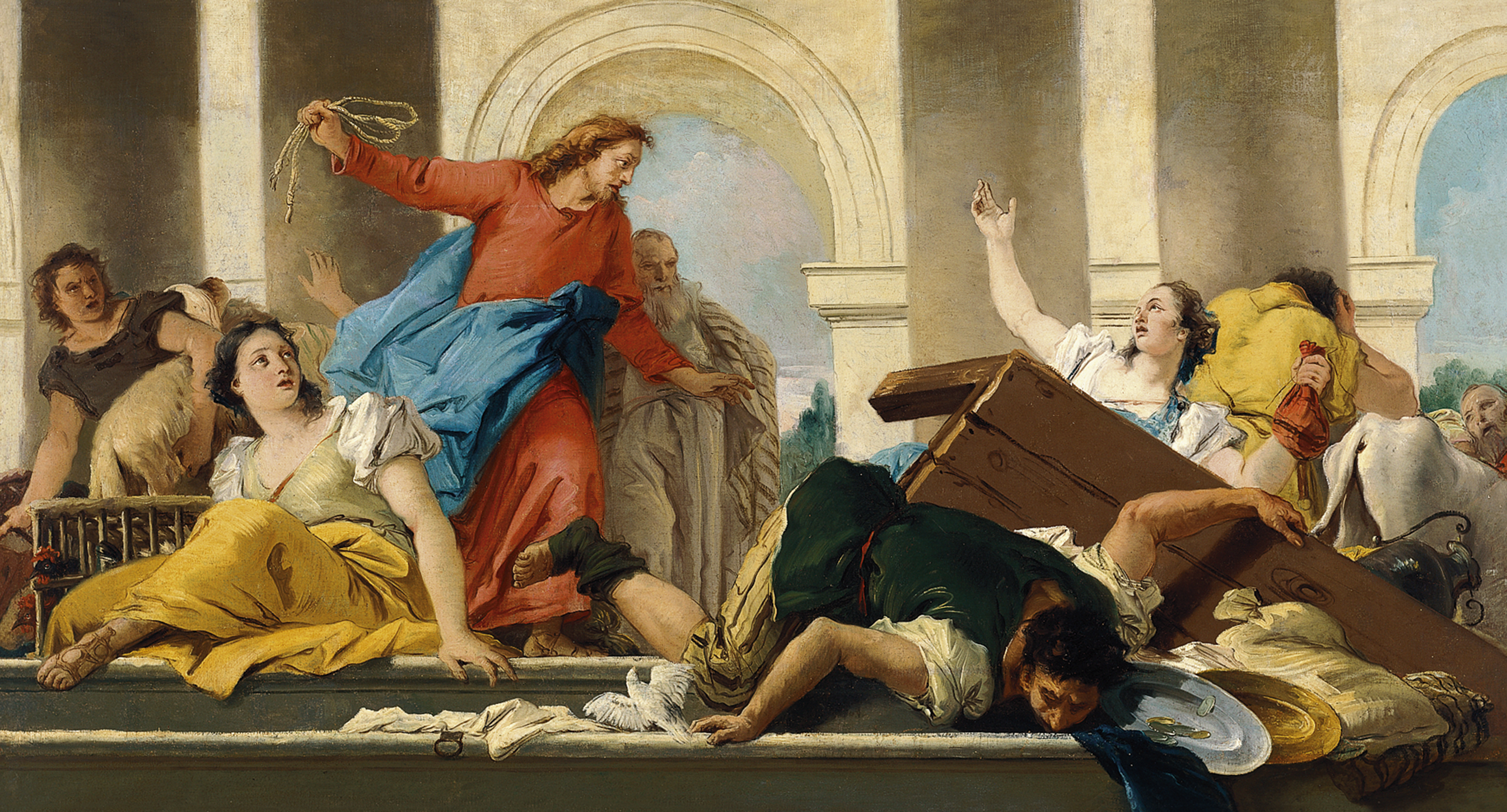
But we should not neglect the time Jesus was less than an adorable, meek and mild fuzzy bunny with people. As we’ll recite together in a few short minutes, “We believe in one Lord, Jesus Christ, the only Son of God, eternally begotten of the Father….[who] by the power of the Holy Spirit he became incarnate from the Virgin Mary, and was made man.” A man, born in human likeness, in human form (see Philippians 2: 1-11). Jesus was not shy about expressing and showing his anger and displeasure. In Matthew 23 for instance he launches into a long, emotional tirade against the scribes and the pharisees and it’s jarring, his anger hot: “You snakes, you brood of vipers! How can you escape being sentenced to hell? (v. 33). His entire focus was the fact of how much the scribes and pharisees were hypocrites, or teaching and saying one thing while doing the opposite. And as most know, he also showed his anger when he overturned the tables of the money changers.

The Expulsion of the Money-changers from the Temple - Tiepolo,  Giandomenico. Museo Nacional Thyssen-Bornemisza

This, oddly, should be comforting. As we continue our pilgrimage, we’ll have times where we are angry. Our Lord can identify with that. But perhaps this too is a double-edged sword: what if that anger – or say the wrath of God – is directed our way, when called to make our accounting?

First, the wrath of God is another misunderstood term in modern imaginations. It comes from the Hebrew Scriptures (our Old Testament) but it’s not like when we see a conflict between two humans, with one seeking revenge against the other for some perceived wrong with the purpose to inflict pain or to hurt.

The Apostle Paul guides us. In Romans he talks about the wrath and judgment of God that will come to those who have rejected the truth, the gospel, and followed evil (See Romans 2: 1-17). Romans 2:5 offers a good perspective on just what God’s wrath is, “But because of your stubbornness and your unrepentant heart, you are storing up wrath against yourself for the day of God’s wrath when his righteous judgment will be revealed.” His wrath appears to be synonymous with his righteous judgment.

Sunday of the Last Judgement (Meatfare Sunday) - Triodion - Greek Orthodox  Archdiocese of America

God’s wrath is not angry retribution against those who have offended God. Rather it is his righteous judgment against those who do evil. God is righteous. And he will judge us according to His righteous standard. And if you take the time to review Romans 2, Paul begins with yet another admonition about judging each other. For Paul, that’s what God has no patience for.

And so, we remind ourselves that we, all of us, are sinners, and we need God; we need Jesus. And by realizing Jesus is the not overbearing task master in today’s parable, the implied judgment actually should not be our focus. We can now shift our thoughts; there are unusual elements present worth looking at, for one, the overabundance of gifts. The basket – or table – is overflowing.

He Prepares a Table | Erica Pyle | Beacon Essentials | Positioned to Prosper

A talent is a vast sum of money and generously distributed to the servants though in different amounts. The master entrusts his wealth to his servants. Not only is he trusting them with his wealth, he does so over a long period of time. As was so painfully evident the other week, our modern culture, which places so much value on things happening immediately, even instantaneously, has become unaccustomed to waiting. Yet here we have another gift, the gift of time, a “long time” in fact, allowing the servants to live faithfully in this superabundance.

And this is where I actually do wonder if our Biblical ancestors perhaps were better suited than we are today when pondering this parable, because their understanding and experience of time radically differs from our sensibilities with respect to time. But the servants already participate, in a yet incomplete fashion, in the life of their master. Think of the master here as inviting his servants into a fullness, a superabundance of grace that is continually offered. Saint Isaac the Syrian framed it this way: God can only give faithful love.

Did Jesus Say, 'God Loves You'? | The Stream

Since God offers faithful love, we should too, should offer each other a superabundance of grace. We know full well conflict is part and parcel of being in communion with each other; that’s as old as, well the Bible. We pray for God’s grace to be extended to us; can we then extend that grace to each other? We’ll of course make mistakes; we’re human. The hardest thing to do I think is to forgive ourselves for the mistakes we make. But we will be held to account for our stubbornness and unrepentant hearts as referenced by Paul in Romans. And lest we forget another almost impossible command from Jesus: becoming reconciled with those whom we have become estranged before approaching the altar, rather than walking away from each other (Matthew 5: 21-27).

Viewpoint: 'Be reconciled with your brother' - The Dialog

What then can be said about the third servant? The judgment still appears to be very harsh doesn’t it? However, by considering this parable as one of invitation, perhaps his plight takes on a different perspective. The master is inviting, continually inviting us into superabundance, grace, and joy (which is really nothing other than an invite into discipleship). Then the only conclusion that can be drawn is the third servant is not able to hear or accept this invitation. The third servant has not only hidden the talent, he has buried himself. The third servant is not so much condemned as he condemns himself to a place—a life—that knows not joy, but knows only darkness, wailing and grinding of teeth. This place, this life, is self-created as a result of an unrepentant heart.

Bridesmaids and Talents – Hood Memorial Christian Church

As those who witnessed Jesus’s ascension realized, endings are a beginning. For you, a beloved ministry is about to end; one is beginning. What was a familiar relationship will change. Endings are a beginning. Let’s encourage one another not to bury our gifts as we approach the unfamiliar. Let’s not bury our talents out of fear. If you feel overwhelmed, sad, or even angry, that’s ok! Burying feelings, even feelings of anger, is not the approach I’m suggesting because it’s not holistic.

Acknowledging Feelings - Sex and Relationship Healing

Like God in Jesus, we are made vulnerable and holy by what we love and lay our hearts out for. We wind our passion like a satin bow, wrapped around what we see as beloved and worthy in our lives. Then, in a thousand different ways, and at the most inconvenient time it seems, God calls us to let go of that precious satin bow, and what it protects, and pushes us to move on. All of us, myself included, are on a lifetime pilgrimage and it just may take us our entire journey on Earth to get over this scandal of our vulnerability. Can we realize we are given the very time of our lives for this very purpose, to be stretched by love, best known and felt in letting go; to have our hearts spread as wide as Christ’s arms spread upon the cross, to lengthen those heart strings.

My passionate Persian desire is for you to develop to the fullness of your capacity and talents. These talents may be latent and you may have to dig for them as you navigate this unfamiliar landscape, but together, we can overcome every difficulty to develop them. It truly is worth every ounce of effort to enlarge natural horizons which then allows the supernatural ones to have room to grow and expand. What I mean is, give Christ room, not only to grow to His full stature in you, but to have a place within you to roam as He may wish, a place for Him to breathe and stretch.

What I pray for is that you then hold on to these discovered gifts, those talents, and offer them, in abundance, for the kingdom, for the unknown unfamiliar other. I know assuming responsibility can feel like a burden. May we be grateful for our God-given gifts and not bury them, even when the reward for using them is greater responsibility. Let us pray:

Lord Jesus, we thank you for your love so strong. May that love flow through us to others.
May we be patient when change comes slowly.
May we be kind when life seems harsh. May we be gentle when others feel bruised.
May we be humble when things go well. May we be peaceful when anger rises within.
May we rejoice when the truth is discovered.
Love never fails, but we do.
May we hope when things seem hopeless.
May we persevere when the way is hard.

Amen.

Perseverance – Limited Edition Canvas | Thomas Kinkade Studios

Awake, O Sleeper

8 Nov

Homily delivered on November 8, 2020 at St. Andrew’s Episcopal Church, Princess Anne, Maryland.

1 Thessalonians 4: 13-18; Psalm 123; Matthew 25: 1-18

This may not make you feel any better, but our readings today and liturgical calendar intersect quite nicely with the current affairs of the world: we’re waiting, with anticipation. We’re waiting for the return of Christ. Liturgically we are approaching another Advent, where in anticipation of the birth of the Christ child, we (hopefully) will push pause and wait, reminding ourselves about the eternal hope we have in Christ. And the entire world waited with us to see how the election would resolve. No doubt, we’ll continue to wait to see how the transition will unfold.

I do lament the heightened consternation that swirls around us right now.  Perhaps we mirror how the initial hearers of Matthew’s Gospel were feeling. The earliest readers of the Gospel had already experienced the dark, painful days after the crucifixion followed by the joyous bright days after the resurrection, and had begun waiting for Christ’s return. This parable then is a challenge to be vigilant and to live in anticipation of the Lord’s coming.

The Second Coming: Will Our Lord Return in the 2020s? — Charisma Magazine

The young women were waiting for the bridegroom. They belonged to the same community, the same group of friends. They fall asleep waiting for the bridegroom to come. We’re not told who has enough oil in their lamps, who has been more faithful. And this really is not for us to know or to judge. No surprise that today the church remains this type of a mixed community. But focusing on who is the foolish or wise would miss the point. The so-called foolish young women also knew the bridegroom, calling out to him “Lord, Lord, open to us!” (verse 11).

That they remain unrecognized by the bridegroom though raises the question of knowledge. What is it to know the bridegroom? What is it to recognize the one called “Lord?” And in turn, what is it to be recognized by the one called “Lord?” The cry “Lord, Lord,” should sound familiar; it takes us back to the earlier chapters of Matthew’s Gospel. “Not everyone who says to me, ‘Lord, Lord,’ will enter the kingdom of heaven, but only the one who does the will of my Father in heaven” (Matthew 7:21). And the lamps (or torches) are also a familiar image previously used in the Sermon on the Mount: “Let your light shine before others, so that they may see your good works and give glory to your Father in heaven” (5:16).

Let Your Light Shine: The Power of Jesus by Lonnie Ollivierre | The Black  Art Depot

Living and waiting (or maybe even sleeping) with enough oil in our lamps, when set in the context of Matthew’s earlier chapters, suggests that it is this spirit of the beatitudes that, above all else, distinguishes those who the bridegroom recognizes. This beatitude spirit is the spirit of the cross, which disrupts and confounds all of our categories, divisions, and all of our judgmental predispositions. The life into which the beatitudes invite us is a life not centered on our works, not even on our faith per se, but on the cross, and how God is glorified through us, through our very lives. 

To live in vigilance then means that as disciples we do the tasks we have been appointed to do in preparation for the Master’s coming. Looking again at Matthew’s Gospel for guidance, those tasks include bearing witness to God’s kingdom by welcoming the stranger, feeding the hungry, visiting the sick and imprisoned (25:31-46), and making disciples in all the world (28:19-20).

Rushing to judge is not supposed to be a part of the spirit of the cross. Judgment is purely reserved for God who alone knows or recognizes each individual; we’ll focus more on that next week. For now, grace is in the cross that shines forth a light, a light so unique that people do not praise our good works but rather praise God who is acting and giving life in the midst of suffering, life in the midst of death, opening the door to those who have engaged the way of the cross, who have engaged the way of death. The world simply cannot understand this way. It does not recognize the Lord though it continually cries out, “Lord, Lord!”

But Christ’s return is actually not a one-time event at some “end point” but rather a continuous event that involves us, the community of Christ, the body of Christ, in our baptismal vocation, our Baptismal covenant: we are to live in the light of the cross, which is walking humbly, in mercy, not in judgment. Our Lord’s return is not just simply about a far-off event but includes Christ’s continual presence with us, now, through our living (even sleeping) and all of our waiting.

Walking Humbly with God | Oblates of St. Benedict

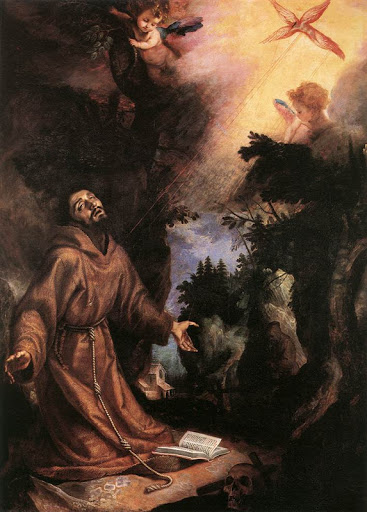
However, too many for me have become caught up in trying to determine the day and the hour of Christ’s return, while others have indeed let their lamps run out.  I thought of St. Francis, Assisi while pondering the readings.  He courageously and humbly walked in a holy wisdom, of being alert.  He often struggled with the sense that the people he encountered daily had become drowsy, sleepy, unaware of the presence of God within them and around them. He desired to help them come awake, alert and to see and to encounter the living and loving presence of God in their midst.

Francis himself went through many conversion experiences throughout his life. Once awakened, Francis no longer saw Jesus the Christ simply as a historical figure, written about in scripture and preached in homilies. Through Francis’ ongoing conversion he experienced Christ alive, who spoke to him and became exceptionally vibrant for him through all of creation. Reading about Francis’ experiences would definitely be worth your time.  Francis’ desire was for everyone to also have this experience of the living Christ.

I ask can we (myself included) be awakened from our slumbering drowsy souls to the brilliance of this Divine Love and Light, the presence of Christ, who shines even in these dark times of the Covid pandemic and the pandemics of violence on our streets, increasing economic disparities, as well as intense political polarization?

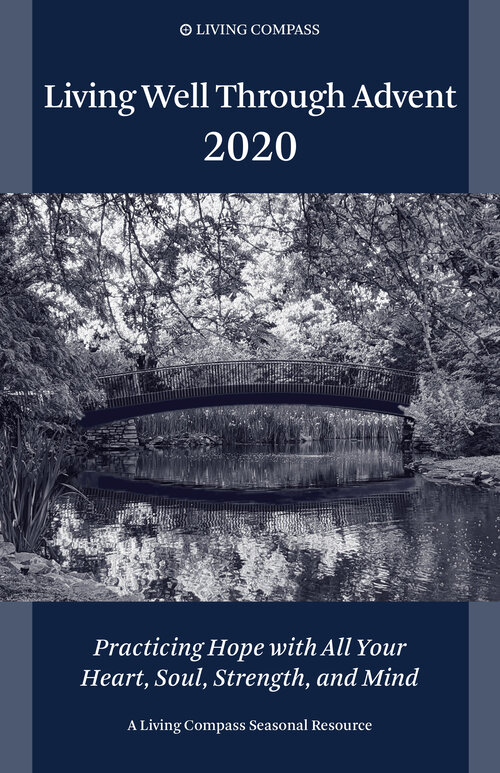
With that I invite you to join me this Advent for a facilitated weekly adult gathering to study and discuss this booklet: Living Well through Advent 2020- Practicing Hope with all of Your Heart, Soul, Strength and Mind.

This invite is for everyone.  We can figure out logistics later but know I am open to perhaps meeting in person with folks, for example immediately after service on Sundays since we are able to appropriately space ourselves.  I am also willing to host a virtual gathering in addition to an in-person discussion, which I can set up via Zoom. There is no charge for the booklets and if we run out of copies, I can provide a PDF link which can be assessed free of charge.

This comes from the Living Compass Program. The booklet is a resource that provides a foundation for seeking a deeper experience of Advent, an experience that will help prepare us for the true meaning of Christmas.  Underlining the program as a whole is the concept of wellness: having a sense of balance by nurturing and tending to all areas of wellness, including spiritual, physical, emotional, relational, and vocational.  Grounded in Scripture and the tradition of the Church, the Living Compass program provides resources, education, training, and support to individuals, families, and congregations who seek to enhance vitality and to live into the abundant life that God intends.

Let us – together – desire to walk in the way of holy wisdom like St. Francis, so that our slumbering and drowsy souls may be awakened in Christ. May this awakening give us the strength and the courage to speak out and to proclaim our faith boldly.

Awake, O sleeper,

rise from death,

and Christ shall give you light,

so learn his love—

its length and breadth,

its fullness, depth, and height.

To us on earth he came to bring

from sin and fear release,

to give the Spirit’s unity,

the very bond of peace.

There is one Body and one hope,

one Spirit and one call,

one Lord, one Faith, and one Baptism,

one Father of us all.

Then walk in love as

Christ has loved,

who died that he might save;

with kind and gentle hearts forgive

as God in Christ forgave.

For us Christ lived,

for us he died

and conquered in the strife.

Awake, arise, go forth in faith,

and Christ shall give you life.

Amen.

4 Ways Jesus Gives You Abundant Life

Which Commandment is the Greatest?

25 Oct
THE GREATEST COMMANDMENT - Uchenna C. Okpalaunegbu Reflection

Homily delivered on October 25, 2020 at St. Andrew’s Episcopal Church, Princess Anne, Maryland

1 Thessalonians 2: 1-8; Psalm 1; Matthew 22:34-36

This morning we join Jesus at the end of a long series of debates and challenges he was subjected to by a variety of groups.  I do not want to diminish the importance and seriousness of the moment, especially since not soon afterwards, some within these groups actively plan to arrest Jesus by stealth and kill him (Matthew 26: 3-4).  But I have to admit; I had a bit of a chuckle when I, a former lawyer recently ordained deacon beginning a new ministry, first reviewed this morning’s readings: and one of them, a lawyer, asked him a question to test him.  “Teacher, which commandment in the law is the greatest?”

Bishop San with the deacons

…. Oh, we lawyers just can’t seem to get a break. Though, to be fair, while we refer to lawyers as someone trained to represent people before a secular court, in the Bible, and with today’s selection, ‘lawyer’ had what we today would call a religious connotation.  This person was undoubtedly an expert and scholar of Mosaic law or the codified system of rules and regulations meant to govern Israel in God’s ways as the nation lived in the Promised Land.

And it was these rules and regulations that Jesus routinely had to address during his ministry.  While the bulletin indicates the Gospel reading is from Luke, it’s actually from Matthew 22:34-46 and I’d like to note that Matthew’s gospel is the most Jewish of the gospels.  What I mean by that is Matthew was written when there was still a living relationship between Jesus’ followers and the Jewish community.  There is considerable concern for the observance of the commandments and Mosaic law.  Indeed, a famous, uniquely Matthean sentence even says that none of the law will pass away until all is accomplished (5:18).  In short, this Gospel seems to be written by and for a community of Jesus’ followers who were overwhelmingly Jewish, not only in terms of ethnicity but also in orientation and patterns of daily living.  And that way of living emphasized wisdom for believing and living a godly life.  The Evangelist has skillfully woven together his source material to produce a compelling portrait of Jesus as both sage and Wisdom itself, as both the revealer of God and Immanuel (“God with us”).

Message: "Immanuel - God With Us" from Phil Helfer — Los Altos Grace

And in Matthew’s rendition, we see this, with Jesus demonstrating he’s cleverer than his adversaries.  And with today’s selection, Jesus ‘gives it right back’ to the Pharisees when he questions them about the messiah and his relationship to David, by quoting Psalm 110.  They are stumped and finally silenced.

But, before the silencing, we have that dreaded lawyer: ‘Teacher, which commandment in the law is the greatest?’  Jesus’ answer fits well with his teaching on the Law or Torah across Matthew. Jesus has already demonstrated that right interpretation of the Torah must view all God’s commands through the lens of the weightier matters of the Torah consisting of justice, mercy, and faithfulness (23:23). Jesus previously cited Hosea 6:6 (Matthew 9:13 and 12:7), emphasizing mercy as central to reading and obeying the Torah. And he has highlighted love of neighbor as the pinnacle command of the Torah (5:43-48). So, keeping in mind the background of Matthew with it being ‘the most Jewish’ of the Gospels, we should not be surprised by Jesus’ quoting Deuteronomy 6:5 (love God with all of your heart) and Leviticus 19:18 (love your neighbor as yourself) as the greatest of commands upon which “all the law and the prophets” hang (22:37-40).

The ancient rabbis put it in similar terms: “What is hateful to you do not do to your neighbor. That is the whole Law.”  Too many times I hear broad brush descriptions of Jesus as a rule breaker or that he wouldn’t agree with organized religion today.  Matthew would push back. 

The Greatest Commandment

The Evangelist bends over backwards to demonstrate Jesus is the one who not only rightly interprets the Torah but as one who commands adherence to even its finest points (see Matthew 5:17-20; I have come not to abolish the law but to fulfill; he encourages people to go further than say the Pharisees and Mosaic law by extending ‘thou shall not murder’ to include an injunction against being angry with fellow believers in Matthew 5:21-26). Jesus’ greatest critique of the Pharisees is not their desire to keep the Torah in its smallest detail but their tendency to fall short on obedience to central values of the Torah (See Matthew 23:23).

The message today then emphasizes that the Torah is rightly understood when it is read through the central lens of love for God and love for neighbor (with even enemies considered neighbors; Matthew 5:43-44). While this truth is not difficult to understand or to preach on its face, embodying love for God and love for others is the greatest of challenges. The sheer breadth of these two commands makes obedience to them a lifelong effort. The all-inclusive reach of these two commandments might be best coupled with some very practical examples of love.  Since Jesus quoted Leviticus 19 with “you shall love your neighbor as yourself” let’s go back to Leviticus 19 to see just exactly how someone loves their neighbor.  A person who loves his or her neighbor:

• Will not reap the fields bare, but will leave some for the poor (vv. 9-10).
• Will not steal (v. 11).
• Will not deal falsely (v. 11).
• Will not lie (v. 11).
• Will not swear falsely by God’s name (v. 12).
• Will not defraud a neighbor (v. 13).
• Will not keep a laborer’s wages overnight (v. 13).
• Will not “revile the deaf or put a stumbling block before the blind” (v. 14).
• Will not render an unjust judgment (v. 15).
• Will not be partial to the poor or defer to the great (v. 15).
• Will judge the neighbor with justice (v. 15).
• Will not engage in slander (v. 16).
• Will not profit by the blood of the neighbor (v. 16).
• Will not hate your neighbor (v. 17).
• Will not take vengeance or bear a grudge (v. 18).

• Will rise before the aged, and defer to the old (v. 32)

.• Will not oppress an alien for the alien is to be as a citizen, loving the alien as yourself (33-34).

Love Your Neighbor | Local News | Bend | The Source Weekly - Bend, Oregon

These verses make it clear that the love of which Leviticus and Jesus speak is different from the warm emotion that we think of as love. Another example to look at is Matthew 25: 31-46 which also demonstrates Biblical love is instead, a way of acting in relationship to our neighbor.  But our culture has equated love with intense emotion. To love is a stronger response than to like. We like chocolate: you can unlock my heart with chocolate peanut butter. We just cannot help ourselves. We love a movie: it entertains or moves us. We love a boy or girlfriend: they make us happy. We love a spouse: they complete us. All are measures of a passive response to something outside us.

Biblical love, however, is not passive and it is not strictly emotional. However, we should not forget the times Jesus is moved with compassion. But the love referred to today by Jesus is the active response of the faithful person to the love of God.  In turn, God’s love is also active. God chooses to love Israel above all nations and to bring his love through this chosen people. To love God with all one’s heart, and soul, and mind, is to choose to respond to God even as God chooses to love us. Feelings and emotions do not enter into the equation.

It refers to what can be called loving-kindness. It is not reactive emotion, but active mercy. It is marked by patience and generosity.  In short, Biblical love is a choice, not a feeling. 

Honest Student Cliparts - Cliparts Zone

Which is helpful because to love God with all our heart, mind, and soul seems nearly impossible when we think of love as an emotion. How does one conjure up feelings for something as remote, mysterious, and disembodied as the concept of God? We cannot look into God’s eyes, wrap our arms around the Spirit, or even see the face of Jesus.  But we are commanded to love an intangible God. Perhaps you may feel like a failure in feeling a deep, abiding affection for a God who is often distant and unknown. I’ve certainly have had my moments of well, being angry at and with God.  Nonetheless, to love God is our duty as Christians.

Love Sums it All - eCommunicator

Likewise, loving our neighbor is difficult. If love is merely our passive response to the person next to us, we are likely to be more indifferent than moved to love. How can one legitimately look into the face of an enemy and feel unqualified love? It is nearly impossible.

Love your neighbor as yourself.” | Dr Ken Baker

Biblical love is something we do. It is merciful action that is both generous and continuous. And that is truly the good news for us as Christian people! A martyred Catholic Sister once said: “Believing in Jesus is believing in humanity, and that is, I believe, the great challenge of our time.” To love neighbor as oneself is to act toward the other as one would act toward those close to you. We treat the stranger as well as we treat those that we love emotionally.

Love your neighbor as yourself; but don't take down the fence.' Carl  Sandburg. | Sally says . . . eat, sleep, work, read, play, draw, bark . . .

Interestingly Leviticus 19 also says “You shall surely rebuke your neighbor” (v. 17), suggesting that love is tough where toughness is needed—or, at times love is to be confrontational so that wrongs might be righted and obstacles to relationships can be removed.  And while not readily apparent, this is partly Paul’s message in this morning’s lesson. 

Although Paul is writing as the founder of the community, the characteristics he upholds are to be reflected in each and every one of the members of the community, not just their leaders. These perhaps can be described as “characteristics of community builders,” and each one of us is such a community builder by our very participation in the Christian community.

Christian Community

As Episcopalians our language is different, but the concept is the same. I encourage you to scroll through our Catechism which begins on page 845 of the Book of Common Prayer, paying particular attention to page 855 with the label The Ministry and its first question: Who are the ministers of the Church? The ministers of the Church are lay persons, bishops, priests and deacons. 

Keeping that in mind (did you catch that lay people are referenced first?) the first characteristic Paul describes is speaking boldly.  Unfortunately, we have lost this with the translation to English.  He traces some history for the Thessalonians, reminding them that when he and his companions first arrived at Thessalonica they had recently spent a tumultuous time at Philippi (Acts 16). Nevertheless, while at Thessalonica, Paul and his companions “had courage … to declare to you the gospel of God” (v. 2). In writing this, Paul uses the Greco-Roman philosophical concept of “bold speech.” This expression was used in antiquity to indicate freedom of speech and courage to speak in the face of opposition.  Paul’s expression draws upon the tradition of a type of speech which is characteristic of ancient philosophers. 

When we are community builders, or ministers, we need to speak boldly and “tell it like it is.” Often the easier route is to avoid conflict and allow things to carry on as always. Yet, to truly build community, the gospel message−the love of God and the love of neighbor−must be proclaimed boldly. To be fearless in speaking out, when one notes moral laxity or the abuse of power taking place within the Christian community, will lead to true community.

We have entered into a covenant to do this.  I encourage you to spend time with the Baptismal Covenant, which we affirm from to time to time, mostly at baptisms. “Will you proclaim by word and example the Good News of God in Christ? – I will, with God’s help. Will you seek and serve Christ in all persons, loving your neighbor as yourself? I will with God’s help.”

Baptismal Covenant – Amy and Joe in Pasadena + Cormack

The second characteristic Paul highlights is personal integrity when he talks about God’s testing.  In Jewish scriptures, God’s testing is a frequent theme and we see that with Jesus’s sojourn into the wilderness before he begins his public ministry.  But I want to move on and conclude with Paul’s third characteristic of community: being a soul sharer.  True community is built upon openness and sharing. We need to open up, to be vulnerable, and to share with those around us.  

Proclaiming the Gospel of loving God and neighbor- requires us to not only share what we know, but how we strive to live what we know and the failings and doubts we have encountered along the way. The images that Paul uses are of a nurse tending to young children (2:7) and later, just beyond today’s selection, a parent, who pleads with them to live a life worthy of God (2:12).

10 Signs Your Partner Is the World's Best Spouse - Signs of a Healthy  Relationship

What have we learned on our own journeys of faith that would make us trustworthy guides to others? To what degree do we need to let others discover their own paths? As they do so, what gifts of knowledge, faith, and insight might they return to us if we are willing to receive them?

Let us pray:

God of Light, shine on us; 

God of Peace, dwell in us; 

God of Might, protect us;

God of Love, enfold us;

God of Wisdom, enlighten us. 

Let us go out as your witnesses

to share the good news of your love

Amen.

Wherever You Go, You Will Always Leave a Footprint: Footprints In The Sand  Journal - Motivational & Inspirational Quotes - Caribbean Tropical Beach:  Journals, Wild: 9781074952754: Amazon.com: Books

Wounded Healers

25 Aug

20190622_200342

Message shared at St. Alban’s Episcopal Church, Eleventh Sunday After Pentecost, Morning Prayer, Sunday August 25, 2019

Readings: Psalm 71: 1-6; Jeremiah 1: 4-10; Hebrews 12: 18-29; Luke 13: 10-17

….Let the words of my mouth and the meditation of my heart be acceptable to you, O Lord, my rock and my redeemer.  Amen (Psalm 19, NRSV).

“For indeed our God is a consuming fire”…well that’s a comforting thought, ‘eh? But let’s be honest, discipleship can certainly feel like that at times, as we muddle about in life, loving God and neighbor.  Case in point, allow me to share a misery of mine from this past week because misery seeks company, right?

As many of you know, I unexpectedly began living here, in Salisbury, just about five years ago. I help my mother care for her partner of 38 years, who has advanced dementia and congestive heart failure. While 90 years old, recently, she has been staying up beyond when mother and I go to bed, watching the Game Show network.  She just loves Steve Harvey and Family Feud.  Because of medical issues I have, I am quite committed to getting to bed at a certain time.  So, I was happily snug as a bug in a rug in my bed, for just over an hour, when all of a sudden, a loud noise and bright light jolts me awake.  With heart racing, I open my eyes and can just make out the door had been opened, with the annoyingly bright hallway light pouring in.  My attention is quickly drawn to a dark figure hovering over me.  The figure starts frantically exclaiming: “I can’t turn off the tv! The remote isn’t working!”  Sadly, I can’t tell you I was the epitome of St. Francis, because my first thought was ‘could you not see I was sleeping, you know, the closed door, darkened room, me under the sheets…no?’

20190621_164612

I gather my senses and realize that the noise was her walker banging against the door as she was opening it.  So, I get up and try to respond in an assuring way, and tell her let’s see what’s happening.  I pass her, and head out the door, take a couple of steps and my right -sockless- foot is consumed and sinks in something wet, cold, and…well chunky.  Evidently, our 15-year-old dog had thrown up after I had gone to bed.

20190220_134519

So, you can no doubt just imagine my posture, and thoughts, as I am still trying to wake up and still trying to gather my senses.

And of course, the issue wasn’t with the remote itself; she was simply using the wrong remote.  But, with dementia, anything out of the ordinary can be considered -and felt- as catastrophic, so once the t.v. was turned off, she calmed down.  And we both went to bed, which, for her culminated in another sound, restful, peaceful night.  And for me, – after cleaning my foot- I had a restless night, with deep sleep hard to resume or come by.

So…one of us, was restored; healed?  Well, with dementia, at least temporarily; that particular moment’s distress and anguish had indeed been alleviated.  And the other…wounded?  By dog vomit? Subsequent lack of sleep, with a sluggish day that followed?

…..Healing. Restoration. Renewal.  With today’s Gospel, we are again reminded that a great portion of Christ’s time was dedicated to healing and curing. We know the stories well.  We know he healed all kinds of people: the blind, the paralyzed, the lame, the deaf, lepers, those who had fevers, many with chronic illnesses.

In fact, earlier in Luke’s Gospel, we learn that John the Baptist sent two messengers to Jesus. They were tasked to ask him whether he was the one who is to come, or whether they were to wait for another. Luke specifically points out that Jesus had just cured many people of diseases, plagues, evil spirits and had given sight to many who were blind.  Jesus responds: “Go and tell John what you have seen and heard: the blind receive their sight, the lame walk, the lepers are cleansed, the deaf hear, the dead are raised, the poor have good news brought to them.  And blessed is anyone who takes no offense at me” (Luke 7: 18-23 NRSV).

Again, we know these stories well.  Perhaps too well; unfortunately, to our detriment.  We can’t possibly relate to the people observing or personally experiencing these healings nor do I think we can relate to the exhilaration that Luke’s initial target audience must have experienced when hearing about the healings during those first initial years the gospel was shared. Imagine this incredible newness; the awe; the wonder.  Perhaps feelings of…renewal?

20190323_175349

We know the woman in the synagogue is healed, on the sabbath.  We know Jesus chastises the hypocrisy of the synagogue leader.  Don’t try Jesus’s patience, on the sabbath of all days! But, do we know to read verses 18-21, in conjunction with this healing episode?  Those four additional verses are other well-known stories: the parable of the mustard seed and the parable of the yeast.

When you get to a Bible, I encourage you to spend time with not only today’s Gospel, but also verses 18-21.  Because it’s clearly Luke’s intent that those parables go with the synagogue healing story, with a ‘therefore’ in verse 18 and an ‘again’ in verse 20.  ‘Therefore’ and ‘again’ are words that tie the story of Jesus healing the woman to his parables of what the kingdom of God is like (see Pervasiveness and Persistence by The Rev. William L. Ogburn, The Anglican Digest, Summer 2019, Vol. 61 No. 2).

And parables, in short, are tangible and engaging analogies that challenge us to encounter reality in a fresh way; parables are central to the way Jesus proclaims God’s reign (ibid p. 38). And when Jesus shares a parable, he is asking us to enter into the scene and to imagine ourselves there (ibid p. 39).

Let’s then briefly focus on the parable of the mustard seed, keeping in mind, it’s connected and tied to today’s Gospel story of the disabled woman who Jesus healed on the sabbath: He said therefore, “What is the kingdom of God like?  And to what should I compare it?  It is like a mustard seed that someone took and sowed in the garden; it grew and became a tree, and the birds of the air made nests in its branches” (Luke 13: 18-19 NRSV).

I’m not a gardener. And let’s just say I wouldn’t encourage any of you to ask me to look after any house plants you have should you be gone for an extended period of time.  But on the occasions that I have had the opportunity to accompany friends or family to any type of gardening type store or farm, I look at seeds, in awe and wonder – these tiny little seeds – knowing that if properly cultivated, it’ll – transform – into not only something bigger with totally different dimensions, but will bear a totally different character from a little seed.  A truly living entity.

We of course know that for that transformation from tiny seed to a full-grown tree, capable of hosting a bird nest, takes time.  And usually, as time passes, additional assistance is needed, whether rain from the sky, or other human endeavors to foster growth.  And then just imagine standing under that tree, consumed in its shade on a hot, hot day; you’re looking up, and seeing the birds of the air taking advantage of that full-grown tree.  Perhaps those birds, shall we say, plant little seedlings of their own (baby birds).  Oh, if those birds could talk, they’d probably be extremely grateful for the shelter and protection that nest provides, saving them from the elements and most predators.

Remember, the parable of the mustard seed is the first that Jesus shares to the synagogue leader, after he heals the disabled woman.  Therefore, the seed sapling to full grown tree, where the birds are eventually saved from toil and care, and where we can perhaps be renewed in its shade during a hot day, is like the kingdom of God.  Once planted, the living tree blossoms.

35882160_10156563866089445_4140847346680332288_n

I find myself back in that synagogue.  I am imagining how that woman will blossom, after 18 long years of suffering.  Jesus saved her from further physical misery.  The birds in our tree are saved from discomfort.  Jesus saves.  That, and Jesus is the way to salvation, unfortunately has become a loaded phrase in our culture, with both being weaponized way too many times.

Interestingly, the Latin root of the word ‘salvation’ or salvus literally means…healed. Christian philosopher and Lutheran theologian Paul Tillich wrote on this and explains that healing perhaps can mean a reunion with God, a reunion with God’s purpose for the world, a reunion with God’s purpose for our lives.   Salvation then is much more than simply not dying but it has to do with truly living.  And how do we truly live?  By letting go.  By letting go of that which is not ours to begin with: control. We did nothing to create or own our life, it’s a gift and we can do nothing to preserve or save it (see Saving by Rev. Aaron Houghton, March 16, 2018).

The woman had 18 long years of crippling misery.  My mother’s partner has no control over the literal loss of her memory.  The woman was cured; alas, my mother’s partner probably won’t be.  But she’s still saved.  St John tells us that we, whether encumbered by illness or not, are saved because God saves us – heals us- by loving us.  And God wants to be in relationship with us, right here, right now, even when we stray from God’s purpose.  Jesus reminds us that God is God of the living, not of the dead (Mark 12: 18-27, NRSV). We in turn, of course love God, but we can’t just stop there.  We love God, by turning towards Christ, and by loving and being in right relationship with our neighbor (see Saving by Rev. Aaron Houghton, March 16, 2018; see 1 John 4: 7-12, NRSV).  St. Ambrose of Milan reminds us that no one heals themselves by wounding another.

20190622_203326

We also heard this morning Jeremiah’s call.  While not many of us receive a prophet’s call, we can look to a portion of Jeremiah’s call for guidance and strength as we pray on our vocation: consecration, insecurity, building up and planting.  God knows us too.  At baptism, we are consecrated for service to the Lord. This community does a mighty fine job building each other up.  And what about planting?  Where is God calling you to plant?  Where is God calling St. Albans to plant?

……Your kingdom come; your will be done, on earth, as it is in heaven.  Yes, the woman is healed and therefore, remember, the kingdom of God is like a mustard seed that someone took and sowed in the garden; it grew and became a tree.  To put it another way, think of it, not as God in the world…but the world in God.

Where is God calling you to heal?  Did you think of yourself as a healer prior to today?  Grant it, while Christ dwells in us (Romans 8: 9-11, NRSV), most of us will not be graced with beyond human ability to tenderly touch someone and immediately cure a devastating, physical ailment.  But I join you if you’re having doubts or feeling insecure as Jeremiah felt when he comprehended what God had in mind. ‘Healer’ would not be the first word I’d use to describe my character or essence.

A seed and a tree is one thing; it would sure be nice to have a blueprint wouldn’t it?  Even assuming everyone outside these walls were Christian, and we find ourselves in the midst of a Christian society, suffering is simply part of the human experience.  How can we heal being wounded ourselves, with the multitude of burdens we carry?

Poet T.S. Eliot addressed this.  He used in one of his greatest poems an image of the wounded surgeon: the surgeon who operates on the sick person but is himself bleeding, wounded, and suffering. This is the Christ-image, which, yes, is stark and shocking as the crucifixion should be stark and shocking had we not become…well, do I dare say, dull to it in many ways.  Calvary is our blue print (see The Crown and the Fire: Meditations on the Cross and the Life of the Spirit by N.T. Wright, p. 110).

Christ carried the burden of God’s consuming fire throughout his ministry: misunderstanding, from family and the disciples, long days, weary nights, combative conversations, to betrayal and eventually a battered, broken body, nailed to a cross.  We proclaim Christ crucified, whose weakness is far greater than our strength (see 1 Corinthians 1:23-25 NRSV).  But the cross is empty.  The good news remains; awe and wonder does too…with us.

20190622_203443

Which means, we, as wounded healers, have a job to do on this side of the kingdom, not just within our families and this congregation, but beyond these walls and in the community.  And the time is now.  Trees do take time to grow; no time like the present to plant that little seed.

What would this look like?  Well, in Eucharistic Prayer C we are reminded that we are not to go the Table solely for solace or pardon but for strength and renewal. So, I encourage folks to consider becoming a Eucharistic visitor.  Talk to —— about training opportunities.  You can be commissioned to take the sacrament to members who are unable to be at worship.  Also, pay attention to the monthly Herald and the community corner, where ——, —— and I have been highlighting local opportunities or places to serve – to heal- the Christ in others.  We are part of the city of the living God; sustained by God since our birth.  May we, with God’s help, seek to sustain others within the city.

Almighty God, give to us and all your people such a vision of your love, and such an understanding of the needs of our society, that we may be the means of bringing the two together, to the glory of your name and the healing of your world: through the fire of your Spirit and in the name of Jesus Christ our Lord. Amen (The Crown and the Fire: Meditations on the Cross and the Life of the Spirit by N.T. Wright, p. 117).

0521161722

Prayer for Peace

1 Feb


prayer-for-peace

I have been at a loss for words.  I have appreciated the messages of concern and support. Modern technology is indeed a beautiful thing at times: Skype, text, email, and yes even social media…it can provide a feeling of fellowship and erase distance.

A movie night with lots of popcorn at #5 could really do me some good right now.  Alas, if I had imminent committed international travel plans, I would cancel them.  Naturalized citizens have also been targeted.

Not that I am surprised by any of this.

In any event, we must remain committed, especially to contemplative practices.  The rediscovery of contemplation should give us hope for the maturing of religion & moving beyond partisan politics.

And the politics certainly will not quiet to tolerable levels any time soon. Reuters now advises its reporters that covering the U.S. will be akin to covering Zimbabwe, China, Egypt, Russia.

With that, I am going to provide a reflection from February’s Give Us This Day: Daily Prayer for Today’s Catholic, titled Prayer for Peace:

To the Creator of nature and humankind, of truth and beauty, I pray:

Hear my voice, for it is the voice of the victims of all wars and violence among individuals and nations.

Hear my voice, for it is the voice of all children who suffer and will suffer when people put their faith in weapons and war.

Hear my voice when I beg You to instill into the hearts of all human beings the wisdom of peace, the strength of justice, and the joy of fellowship.

Hear my voice, for I speak for the multitudes in every country and in every period of history who do not want war and are ready to walk the road of peace.

Hear my voice and grant insight and strength so that we may always respond to hatred with love, to injustice with total dedication to justice, to need with the sharing of self, to war with peace.

O God, hear my voice and grant unto the world Your everlasting peace. (St John Paul II)


“The root of all war is fear,” the Trappist monk Thomas Merton wrote.  This line has echoes in St. John Paul II’s prayer for peace, as he calls upon the creator of all to give us strength to overcome the fear that leads to so many in our world to put “their faith in weapons and war.”

And yet, as Merton and John Paul II would attest, it is more than battle lines and firearms that define war.  Violence, division, hatred– these evils arise from the seed of fear planted in our hearts, nurtured by our self-interest, and harvested by a worldly logic that says “you come first” and “each one for themselves.”  I may not shoot, stab, or bomb another person, but in so many ways I find myself nourishing that seed of fear with my self-righteousness and disregard for others such that, as Pope Francis often says, my conscience grows numb and my heart cold to the concerns and needs of others.

Even our everyday language is filled with the violent imagery of war: war on terror, war on drugs, war on poverty, and so on.  But something about this way of speaking and thinking doesn’t sit comfortably alongside a faith that believes in a God who enters our world as the Prince of Peace.

If we saw the suffering and inequity that lead desperate individuals to acts of terror, we would respond with God’s commandment to love.  Instead, we declare a war on terror and bomb strangers from drones.

If we saw the agony and illness of addiction that drives the drug trade, we would respond with appropriate support and care.  Instead, we declare a war on drugs and put more of the vulnerable in prison.

If we saw the systems of injustice and oppression that lead to poverty, we would respond by working to reform these structures of evil.  Instead, we declare a war on poverty and blame victims who never had a chance, proclaiming from our positions of comfort that they should simply “get a job.”

Indeed, the root of all war is fear.  But if we wish to aid God in answering St. John Paul II’s prayer, we must begin by acknowledging the fear in our own hearts and allow God’s peace, which the world cannot give, to take root instead (Fr. Daniel P. Horan, OFM, Franciscan friar and author of several books, including God is Not Fair and Other Reasons for Gratitude.  To learn more, go to his website DanHoran.com).